

Story
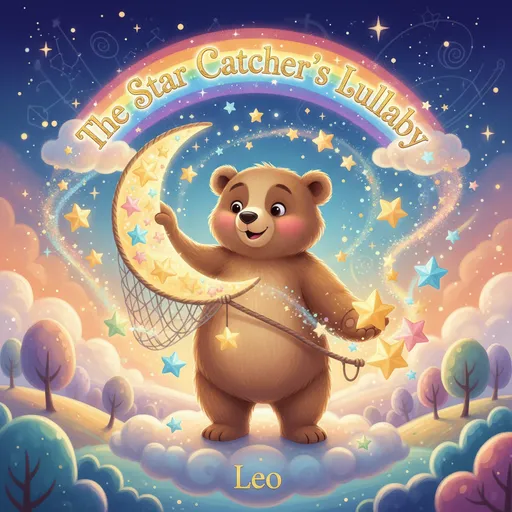
The Star Catcher's Lullaby
60 minAges 7-9
This is the start of the story. The whole story plays in the Sonacast app.
The story
Introduction
Welcome, sleepy stargazers, to The Star Catcher's Lullaby. Tonight, we'll embark on a magical journey with a very special bear named Leo. As the world settles down for the night, Leo has an important job: to help gather all the twinkling stars and discover their wondrous secrets before bedtime. It's a cozy tale designed to fill your dreams with warmth and light. Get ready to drift into a world of celestial wonder, because our adventure begins the moment Leo opens his eyes to a truly sparkling mystery.
Leo Wakes Up to a Twinkling Mystery
Our story begins, not with a sudden jolt, but with the gentle stirring of Leo, the Star Catcher bear, as the last vestiges of twilight painted the horizon. He stretched, a deep, contented sigh escaping his chest, and then his eyes, sharp and bright, turned instinctively towards the darkening sky. Tonight, however, something was different. A particular star, usually a quiet, steady beacon, was pulsating with an unusual rhythm, its light seeming to ebb and flow, almost like a tiny, celestial heartbeat. This wasn't merely a twinkle; it was an active, observable change, a genuine mystery unfolding in the velvet expanse above. Leo knew his job wasn't just to gather stars, but to understand them, to appreciate the unique narratives etched into their very being. He wondered what kind of star could exhibit such a distinct pattern. Was it a variable star, one that naturally brightens and dims over time, or perhaps something even more extraordinary, like a dying star experiencing a final, spectacular flourish? The universe, after all, is a dynamic place, full of stellar objects that defy simple categorization. This particular star’s erratic sparkle presented a delightful challenge, an invitation to delve deeper into the science of stellar luminosity and the myriad ways stars express their cosmic existence. Leo felt a familiar tingle of anticipation, a blend of curiosity and scientific fascination. He knew that each star held a story, a complex interplay of physics and cosmic history, and this pulsating light was beckoning him to uncover its secrets, to learn about the incredible processes that make stars shine in so many fascinating ways across the universe.
The Whispering Wind and the Glimmering Net
As Leo pondered the peculiar pulsation of the mysterious star, a soft, whispering wind began to rustle through the leaves of the ancient oak tree beside his cozy den. It wasn't just any wind; it carried with it the faint, almost imperceptible scent of distant stardust and the cool, silent breath of the cosmos. This was the wind that always signaled it was time for Leo to begin his nightly task, guiding him towards the celestial wonders awaiting his gentle observation. He reached for his most trusted tool: the Glimmering Net. Now, this wasn't a net in the traditional sense, made of twine or rope. Instead, the Glimmering Net was a marvel of cosmic craftsmanship, woven from strands of pure moonlight and imbued with the power to capture and magnify starlight, allowing Leo to truly 'see' and understand the stars up close, without ever disturbing their majestic dance. It was, in essence, an advanced astronomical instrument, allowing for unparalleled observation and data collection. The net could focus the faint photons of light emitted by distant celestial bodies, bringing their intricate details into stunning clarity. Think of it like a highly sophisticated telescope combined with a spectrometer, enabling Leo to analyze the composition, temperature, and motion of stars. When he unfurled it, the net shimmered with a soft, ethereal glow, its delicate threads seeming to hum with collected starlight from countless nights past. Each intricate filament acted like a fiber optic cable, drawing in light and channeling it to Leo's keen eyes, translating the raw data of the universe into an understandable visual and even tactile experience. He ran his paw over its surface, feeling the subtle vibrations of captured cosmic energy, a reminder of the immense power and beauty held within each distant sun. This net allowed him to perceive not just the visual brilliance of a star, but also the nuances of its light spectrum, revealing clues about its age, its chemical makeup, and even the speed at which it was moving through the vastness of space. It was through this net that Leo would truly embark on his nightly quest, not to physically pluck stars from the sky, but to gather their light, their secrets, and their stories, bringing them closer for our understanding. The wind whispered again, a gentle urging, and Leo, with his Glimmering Net now poised and ready, stepped out into the deepening night, prepared to unravel the intricate tapestry of the cosmos, one twinkling mystery at a time. He understood that light, the very essence of a star, carries an incredible amount of information, much like a cosmic messenger. The Glimmering Net was his perfect conduit for receiving those messages, for interpreting the subtle shifts in color, intensity, and position that reveal the profound life cycles and characteristics of these distant suns. As he held the net aloft, it seemed to drink in the ambient light, growing brighter, more responsive, eager to begin its work. The journey of discovery was about to unfold, guided by the whispering wind and powered by the intricate design of his remarkable Glimmering Net, a tool that bridged the gap between observer and observed in the most profound way imaginable. This remarkable instrument represented the pinnacle of stellar observation, allowing for a deep, almost intimate, connection with the celestial objects it was designed to study, enabling Leo to translate the silent language of the stars into meaningful knowledge for all of us.
Twinkle's Tiny Song of Joy
Leo’s gaze, guided by the Glimmering Net, settled first upon a very small star he affectionately called Twinkle. Unlike the mysterious pulsating star that initially caught his attention, Twinkle emitted a steady, gentle glow, a quiet testament to its youth and vigor. Twinkle was a perfect example of a T Tauri star, a young, pre-main-sequence star that is still in the process of contracting under gravity and has not yet begun hydrogen fusion in its core. These stars are typically found surrounded by protoplanetary disks, which are swirling masses of gas and dust from which planets may eventually form. Twinkle's ‘tiny song of joy’ was, in fact, the subtle, high-frequency oscillations of its surface, indicating its energetic youth and the turbulent processes occurring within its nascent being. Through the Glimmering Net, Leo could discern faint wisps of gas and dust swirling around Twinkle, evidence of the stellar nursery from which it had just emerged. This nursery, known as a nebula, is an interstellar cloud of dust, hydrogen, helium, and other ionized gases. Nebulae are the birthplaces of stars, vast cosmic canvases where gravity slowly pulls together diffuse matter, eventually collapsing it into dense cores that ignite into stars. Twinkle was still nestled within the outer reaches of its parent nebula, a shimmering, colorful cloud of cosmic material. Leo focused on the specific spectral lines emitted by Twinkle, which told him about its chemical composition, predominantly hydrogen and helium, the fundamental building blocks of the universe. The presence of certain heavier elements, though in smaller quantities, provided clues about the previous generations of stars that had lived and died, enriching the interstellar medium with their processed elements. He observed how Twinkle, despite its small size, was actively shedding matter in powerful stellar winds, a characteristic common in young, rapidly evolving stars. These winds play a crucial role in clearing away the surrounding gas and dust, eventually allowing the newly formed star to shine more clearly. He could also detect the faint, irregular flares emanating from Twinkle’s surface, indicative of its turbulent magnetic field, a common feature in young stars that have not yet settled into a stable rotation. These flares, while energetic, contributed to Twinkle's 'song' rather than disrupting it, adding a vibrant, almost playful note to its existence. Leo felt a profound connection to Twinkle, recognizing the universal journey of birth and growth playing out in this distant celestial body. Twinkle's tiny song was a lullaby for the cosmos, a promise of new beginnings, and a reminder of the continuous cycle of creation and renewal that defines the universe, from the smallest star to the grandest galaxy. It was a beautiful illustration of how stars begin their lives, evolving from clouds of gas and dust into brilliant beacons of light that illuminate the vast expanse of space, each with its own unique story to tell, a story that Leo, with his Glimmering Net, was privileged to hear and understand.
Zoomer, the Star Who Loved to Play Tag
Next, Leo turned his Glimmering Net towards a more boisterous celestial resident, a star he affectionately named Zoomer. Zoomer wasn't just shining; it was practically dancing across the cosmic stage with an incredible velocity. This particular star was a fascinating example of a runaway star, ejected from its birthplace by a powerful gravitational slingshot effect, often caused by interactions with other massive stars or even a supernova explosion in a binary system. Zoomer’s extraordinary speed, measured in hundreds of kilometers per second, was evident through the pronounced Doppler shift in its spectral lines, an effect Leo could clearly discern with his net. The light from Zoomer was slightly shifted towards the blue end of the spectrum, indicating it was rapidly approaching a certain point in space relative to its origin, before it would eventually recede and exhibit a red shift. This stellar 'tag' was not merely a whimsical game; it was a profound demonstration of the intricate gravitational forces at play within star clusters and galactic environments. Leo tracked Zoomer’s trajectory across several hours, noting its precise path and estimating its origin. He deduced that Zoomer likely belonged to a binary or even a triple star system that suffered a catastrophic disruption. Imagine two or three stars locked in a gravitational embrace, performing an elegant cosmic ballet. If one of these stars explodes as a supernova, or if a close encounter with another massive object occurs, the delicate balance can be shattered, flinging one or more stars away at immense speeds. Zoomer’s journey was a lonely one, far from its original stellar companions, a testament to the violent yet creative processes that shape our galaxy. Leo observed how Zoomer, despite its rapid movement, maintained its integrity, a testament to the immense internal forces that hold a star together. Its light was crisp and stable, indicating a main-sequence star, steadily fusing hydrogen into helium in its core, much like our own Sun, but with a far more dramatic backstory. The Glimmering Net allowed Leo to visualize not just Zoomer's current position, but also its projected path through the interstellar medium, a vast, thinly distributed collection of gas and dust that stars like Zoomer travel through. Its journey was a cosmic saga, a perpetual game of tag with the invisible forces of gravity and inertia, playing out over millions of years. Zoomer reminded Leo that the universe is not static; it is a place of constant motion, interaction, and dramatic events, where stars are not just fixed points of light but dynamic entities with incredible velocities and epic journeys, each contributing to the grand, ever-unfolding narrative of the cosmos. Its playful 'tag' was a serious scientific phenomenon, offering invaluable insights into the dynamics of stellar systems and the powerful gravitational interactions that shape the galactic landscape, making it a compelling subject for Leo's nightly observations.
Puffy Cloud, the Dream Weaver Star
Following Zoomer's energetic display, Leo’s gaze, guided by the Glimmering Net, drifted towards a much more serene sight: a star he affectionately named Puffy Cloud. This celestial body was a stark contrast to the youthful Twinkle and the racing Zoomer. Puffy Cloud was an aging giant, specifically a red giant, a star in the later stages of its stellar evolution. Its immense size was immediately apparent, appearing as a vast, diffuse sphere of incandescent gas, many times larger than our own Sun, yet surprisingly dim in comparison to its volume. The 'puffy cloud' description came from its distended, tenuous outer layers, which had expanded dramatically as its core ran out of hydrogen fuel. Through the Glimmering Net, Leo could clearly observe the characteristic reddish hue of Puffy Cloud, a direct indicator of its cooler surface temperature compared to younger, hotter stars. This lower temperature is a consequence of the star’s expansion; as the outer layers swell, the energy generated in the core is spread over a much larger area, causing the surface to cool. Despite its cooler surface, the core of Puffy Cloud was still incredibly hot and dense, actively fusing helium into heavier elements like carbon and oxygen. This process is crucial to the creation of the elements that make up planets and life itself. Leo studied the spectroscopic data, identifying the distinct absorption lines of these heavier elements in Puffy Cloud's atmosphere, confirming its advanced evolutionary stage. He also noted the subtle pulsations of Puffy Cloud, a common feature in many red giants. These pulsations are caused by instabilities within the star’s outer layers, which expand and contract over periods of days, weeks, or even months. This rhythmic swelling and shrinking is often accompanied by a gentle shedding of the star's outer atmosphere into space, creating a vast, expanding shell of gas and dust around it. This expelled material, rich in newly formed heavy elements, will eventually seed the interstellar medium, contributing to the formation of future generations of stars and planets. In a profound way, Puffy Cloud was a 'dream weaver' star, not just because of its soft, cloud-like appearance, but because it was actively contributing the raw materials for future cosmic dreams, including the very elements that form us. The Glimmering Net allowed Leo to witness this majestic, slow-motion transformation, a star gently, almost elegiacally, preparing to transition to its next phase. It was a powerful reminder of the cyclical nature of the universe, where even the end of a star's active life is a beginning for something new. Puffy Cloud was a cosmic elder, sharing the precious elements forged in its heart with the vast cosmos, ensuring the continuation of the grand celestial narrative, a testament to the profound and beautiful interconnectedness of all things in the universe.
The Peek-a-Boo Star Hiding in the Moonbeams
As the night deepened, Leo turned his Glimmering Net to an area of the sky where, according to his star charts, a particular star ought to be visible. Yet, tonight, it played a delightful game of 'peek-a-boo,' subtly hidden from direct view, its light only hinting at its presence through the silvery veil of the moonbeams. This was a marvelous example of a star obscured by an interstellar cloud, or nebula, rich in cosmic dust. These dust clouds are not empty space; they are vast, tenuous regions of interstellar medium composed of microscopic solid particles, primarily silicates, carbon compounds, and ice. Through the Glimmering Net, Leo could detect the faint, reddish glow around where the star should have been. This phenomenon is known as interstellar reddening or extinction, where shorter wavelengths of light, like blue light, are scattered and absorbed more effectively by the dust particles than longer wavelengths, like red light. As a result, the star's light appears dimmer and redder than it truly is, making it seem as if it's playing a cosmic game of hide-and-seek. The moonbeams, diffused and scattered themselves, added another layer to this visual trick, making the star's faint presence even more elusive. Leo meticulously adjusted the Glimmering Net's filters, allowing him to penetrate the dust veil and gather more specific data about the hidden star. He could discern that it was a relatively young, hot, blue-white star, but its true brilliance was heavily masked by the intervening dust. This observation was crucial because it allowed him to calculate the density and composition of the obscuring dust cloud, providing valuable insights into the properties of the interstellar medium in that particular region of space. Such dust clouds are not merely obstacles; they are vital components of galactic evolution, serving as sites for molecule formation and as the raw material for new star and planet creation. The 'peek-a-boo' star, despite its elusive nature, offered a profound lesson about perception and the vastness of space. It taught that what we see with the naked eye is often only a fraction of the full picture, and that specialized tools, like Leo’s Glimmering Net, are essential for unveiling the deeper truths of the cosmos. It was a beautiful reminder that even in seemingly empty stretches of sky, there are hidden wonders, waiting for us to peer through the veil and discover their secrets, much like a child peeking from behind a curtain, revealing its joyful presence only when sought with genuine curiosity and the right perspective. This star, in its temporary concealment, highlighted the dynamic interplay between light, matter, and observation in the universe, emphasizing that much of the cosmos remains veiled, inviting us to look closer, to understand more deeply.
Sparkle and the Story of Sharing Light
From the hidden depths of the peek-a-boo star, Leo's Glimmering Net then gracefully swept across the sky to capture the essence of a remarkable pair he called Sparkle. Sparkle wasn't just one star, but two, locked in a mesmerizing celestial dance: a binary star system. These systems are incredibly common in our galaxy, with more than half of all stars believed to be part of a multiple-star system. What made Sparkle so captivating was the apparent sharing of light between its components. Through the Glimmering Net, Leo observed how their combined radiance created a unified, yet subtly distinct, glow, a testament to their mutual gravitational embrace. One component, a brighter, hotter main-sequence star, was actively fusing hydrogen, while its companion, a slightly dimmer, cooler star, orbited it in a graceful ellipse. The interplay of their light was not merely additive; it was a complex dance of eclipses and tidal interactions. When one star passed in front of the other from Leo's perspective, the combined light dipped, revealing the individual contributions of each. This phenomenon, known as an eclipsing binary, allowed Leo to precisely measure their orbital periods, their sizes, and even their masses, by observing the subtle changes in their combined brightness over time. He could also detect the gravitational effects each star had on the other, subtly distorting their shapes into ovoids rather than perfect spheres, a process known as tidal distortion. The light they 'shared' wasn't just physical photons; it was also a shared gravitational influence, a shared cosmic history. They were born from the same nebula, grew up together, and would likely end their lives in a synchronized, albeit distinct, manner. This concept of shared light extended beyond just binary systems, to entire star clusters, where thousands of stars, born from the same colossal gas cloud, illuminate their cosmic neighborhood collectively. Constellations, though often appearing as random groupings from Earth, are conceptualizations that draw lines between stars that appear close to us, forming patterns that tell stories. The light from each star in a constellation, though originating from vastly different distances, combines in our eyes to create these recognizable shapes. Sparkle, the binary system, was a micro-representation of this larger cosmic truth: that stars, whether in pairs, clusters, or as individual beacons, are all part of a grander narrative of shared illumination. They collectively brighten the vast cosmic ocean, each contributing its unique radiance to the universal tapestry. The story of Sparkle was a powerful lesson in collaboration and interconnectedness, showing how even individual lights, when brought together, can create something far more profound and beautiful, casting away the shadows of the universe with their combined, shared brilliance.
The Great Golden Star's Warm Embrace
After observing the intricate dance of Sparkle, Leo's Glimmering Net sought out a presence that was both familiar and profoundly comforting: a great golden star, radiating a warmth that seemed to transcend the vast distances of space. This was not just any star; it represented the quintessential stable star, much like our own Sun, a steadfast beacon in the cosmic night. Its golden hue spoke of a mature, main-sequence star, steadily converting hydrogen into helium in its core through the process of nuclear fusion. This fusion is the engine of a star, releasing immense amounts of energy in the form of light and heat, which then radiate outwards, providing life-sustaining warmth to any planets orbiting it. Through the Glimmering Net, Leo could discern the star’s incredibly stable luminosity. Unlike the variable stars or young, flaring stars he had observed earlier, this golden star maintained a consistent output, a testament to the delicate balance between the inward pull of gravity and the outward push of radiation pressure from its core. This hydrostatic equilibrium is what allows stars like our Sun to shine steadily for billions of years, providing a reliable source of energy for complex biological evolution. He focused on the star’s spectral lines, which revealed a rich composition of elements forged in previous stellar generations, now being recycled and incorporated into this new, stable star. The presence of these heavier elements, though small in percentage compared to hydrogen and helium, is crucial for the formation of rocky planets, which require elements like silicon, iron, and oxygen to coalesce. The 'warm embrace' of this golden star was not merely metaphorical; it was the actual, tangible energy that flowed from its heart, traversing unimaginable distances to touch and nourish potential worlds. Leo observed faint evidence of a planetary system orbiting this star, tiny shadows periodically dimming its light, a phenomenon known as a transit. These transits indicated the presence of exoplanets, worlds nurtured by the star's consistent warmth, potentially harboring conditions suitable for life. The great golden star symbolized stability, longevity, and the nurturing power of a cosmic parent. It reminded Leo of the profound connection between a star's steady light and the emergence of life, emphasizing that the universe is not just a collection of isolated objects, but an interconnected system where one element's stable existence creates the conditions for another's blossoming. This steady, golden glow was a cosmic reassurance, a silent promise that even amidst the vast and dynamic universe, there are anchors of light and warmth, providing the enduring embrace that allows for the miracle of existence, a truly remarkable testament to the sustaining power of a star.
Gathering All the Twinkles for Bedtime
As the night began its slow transition towards dawn, Leo knew his time for observation was drawing to a close. With his Glimmering Net, he began the final, crucial phase of his nightly task: gathering all the twinkles for bedtime. This wasn't about physically collecting the stars, but about assimilating all the diverse information, the unique 'twinkles' of each star he had encountered, into a cohesive understanding of the night sky. He mentally revisited Twinkle, the young T Tauri star still emerging from its nebula, full of youthful energy and shedding matter into space. Then he recalled Zoomer, the runaway star, a testament to the violent gravitational slingshots that can hurl stars across vast cosmic distances. Puffy Cloud, the red giant, came to mind, a dream weaver shedding its outer layers to enrich the interstellar medium with new elements. He remembered the Peek-a-Boo star, its light reddened and obscured by cosmic dust, teaching him about the unseen elements of the universe. And of course, Sparkle, the binary system, a beautiful example of shared light and gravitational dance, and the great golden star, a symbol of steady, life-giving warmth. Each star, with its distinct characteristics and journey, contributed to the grand tapestry of the cosmos. Leo understood that 'gathering' these twinkles meant recording their data, filing away their stories, and appreciating the immense diversity of stellar life cycles. He focused the Glimmering Net one last time, not on a single star, but sweeping it across the entire celestial dome, allowing its delicate threads to absorb the collective light of thousands of stars, each one a distant sun, each with its own incredible tale of birth, life, and eventual transformation. This final sweep was a synthesis, a moment of profound integration, bringing together all the individual lessons into a holistic appreciation of the universe's complexity and beauty. He imagined the faint, individual 'songs' of each star, blending into a harmonious celestial chorus, a grand lullaby for the sleeping world. The Glimmering Net, now saturated with the night's observations, seemed to glow with a gentle, inner light, reflecting the myriad secrets it had helped Leo unveil. This act of gathering was also about making sense of the constellations, recognizing that these patterns, though arbitrary from a scientific standpoint, served as useful celestial landmarks, helping humanity navigate both physically and imaginatively through the stars for millennia. Leo's task for the night was complete. All the twinkles were accounted for, their stories understood, and their light, in its various forms, was now safely 'gathered' within the archives of his mind and the data stored within the shimmering filaments of his net. The sky, though still dark, now held a deeper meaning, its familiar patterns enriched by the knowledge of the individual stellar lives playing out within them, preparing for the peaceful slumber before the next cycle of observation. It was a beautiful culmination of his nightly duty, turning scattered light into organized understanding, ready to be shared.
The Star Catcher's Own Sweet Lullaby
With all the twinkles safely gathered, their stories understood, and their lights recorded within his Glimmering Net, Leo found a quiet spot under the ancient oak tree. The first faint hints of pre-dawn light were just beginning to soften the eastern horizon, painting the sky with hues of soft lavender and rose. He looked up at the stars, which, though still numerous, seemed to have settled into a calmer, more peaceful glow. His own heart felt full, not just with the knowledge he had gained, but with a profound sense of wonder and connection to the vast universe. Leo knew that even as the world on Earth prepared to awaken, the stars would continue their silent, majestic journeys, each one a distant sun, performing its cosmic dance, fusing elements, and radiating light across unimaginable distances. The universe doesn't sleep; it simply shifts its observable beauty with the rotation of our planet. The lullaby he now felt was not just for the stars, or for the sleepy world below, but for himself. It was a sweet, internal melody, born from the quiet satisfaction of a job well done, of mysteries explored, and of beauty appreciated. He understood that the grand cosmic ballet was always in motion, whether we were watching or not. The nebulae continued to birth new stars, red giants continued to shed their elements, binary systems continued their gravitational waltz, and stable golden stars continued to provide their life-giving warmth. This constant, eternal cycle was itself a comfort, a universal rhythm that transcended all earthly concerns. Leo thought about the incredible power of light, the ancient messenger that brings us tales from billions of years ago, allowing us to peek into the distant past and understand the processes that shaped our present. He reflected on how each star, no matter how small or distant, plays a crucial role in the grand narrative, contributing its unique sparkle to the collective brilliance of the cosmos. As the first rays of the Sun began to peek over the horizon, gently fading the visible stars, Leo closed his eyes. The Glimmering Net, now folded and resting beside him, hummed softly, a faint echo of the night's celestial symphony. He drifted into a peaceful slumber, his dreams filled with the gentle hum of fusion, the silent dance of gravity, and the endless, twinkling possibilities of the universe, knowing that the stars, even unseen, were still there, singing their own sweet lullaby, and waiting patiently for him to return to their magnificent secrets on another night. It was a profound moment of peace, a bear and his universe, intertwined in a timeless, cosmic embrace, ready for rest and renewal before the next journey of discovery.
Outro
And so, our journey with Leo, the Star Catcher bear, concludes for tonight. We hope you've enjoyed drifting through the celestial wonders and uncovering the secrets of the stars. May your dreams be filled with the gentle glow of distant suns and the quiet magic of the cosmos. Thank you for joining us on The Star Catcher's Lullaby. We appreciate your company on this cosmic adventure. Please consider leaving us feedback on Sonacasts, as your thoughts help us make our podcast even better. Until next time, keep looking up and dreaming brightly.


