

Story
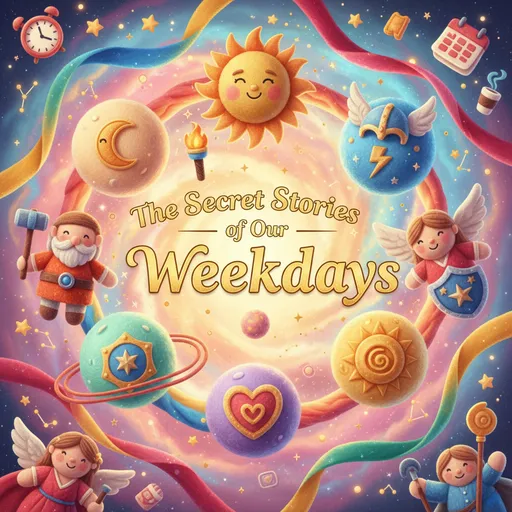
The Secret Stories of Our Weekdays
15 minAges 7-9
This is the start of the story. The whole story plays in the Sonacast app.
The story
Introduction: Unlocking Weekday Secrets
Have you ever wondered why we call today 'Monday'? Or why 'Sunday' is called 'Sunday'? It's not just a name, it's a secret! Long, long ago, people looked up at the sky and saw bright planets and shiny stars, and they gave our weekdays special names, often after their brave gods or the glowing lights above. Join us on a super fun adventure to discover the hidden stories of Monday, Tuesday, Wednesday, and all the other days! Get ready to unlock the magic behind each day of our week!
Segment 1: Sun, Moon, and the Start of the Week
What an exciting journey we're about to embark on, discovering the ancient magic hidden right in our calendar! As you just heard, the very first days of our week are named after the brightest lights we see in the sky: the Sun and the Moon. Isn't that incredible? Let's dive in and shine a spotlight on Sunday, a day that truly lives up to its name. Sunday is, quite simply, the Sun's Day! Can you imagine a world without the sun? It gives us light, warmth, and helps everything grow. For ancient people, the sun was incredibly important, a giant, powerful star that made life possible. They worshipped it and saw it as a source of energy and joy. So, it made perfect sense to dedicate one special day of the week to this magnificent celestial body, a day for rest, brightness, and perhaps a little bit of sunshine in their hearts. Think of Sunday as a bright, warm hug from the sky, a reminder of all the good things the sun brings us. It's a day for feeling refreshed and ready for adventure, just like the sun rising anew each morning, full of promise. The sun's constant presence, its predictable rising and setting, gave ancient civilizations a way to measure time. It was their first, most reliable clock, helping them organize their planting, harvesting, and even their celebrations. And what about the day that follows? As the bright sun sets and the stars begin to twinkle, a gentle, silvery glow appears in our night sky. That's right, next we have Monday! And Monday is the Moon's Day. The moon, our loyal companion in the night, has inspired stories and songs for thousands of years. It doesn't shine with its own light, but instead reflects the sun's glow, making it a gentle, mysterious presence. Ancient people watched the moon carefully, noticing how it changed shape from a tiny sliver to a full, round orb and back again. These changes, called phases, helped them keep track of longer periods of time, like months. For many cultures, the moon was seen as a symbol of calmness, change, and mystery. They believed it had a special connection to tides and even to feelings. So, Monday, the Moon's Day, often felt like a slightly calmer, more thoughtful day, perhaps a day for reflection after the bright energy of Sunday. Imagine the ancient sky-watchers, sitting around a crackling fire, looking up at the vast, dark canvas sprinkled with stars, with the moon glowing softly above them. They saw patterns, told stories, and felt a deep connection to these heavenly bodies. They didn't have fancy telescopes or space rockets, but their curiosity was just as strong as ours. By naming their days after the sun and moon, they created a rhythm for their lives, a way to honor the things that shaped their world most profoundly. Every time you say 'Sunday' or 'Monday', you're actually speaking words that have traveled through centuries, carrying with them the wonder and wisdom of people who lived long, long ago, people who found magic in the sky above. These aren't just labels; they're echoes of ancient awe.
Segment 2: Brave Warriors and Wise Wanderers
From the dazzling lights of the Sun and Moon, our journey through the week now leads us to days named after incredibly brave and wise figures from ancient stories! These aren't just any figures; they are powerful gods from Norse mythology, a collection of exciting tales from Northern Europe, full of heroes, monsters, and magic. Let's leap into Tuesday! Have you ever felt really brave, like you could face any challenge? Well, Tuesday is Tiw's Day, named after Tiw, a very courageous Norse god. He was known as the god of single combat and heroic glory, always ready to protect others and stand up for what was right. In fact, if you've heard of the Roman god of war, Mars, you might notice some similarities, because Tiw was the Norse equivalent. He wasn't just about fighting; he represented justice and honor. One famous story tells how Tiw sacrificed his hand to trick a giant wolf named Fenrir, so that the other gods could chain it and keep the world safe. That's how dedicated and brave he was! Because of Tiw's strong spirit, Tuesday often felt like a day for being bold, for starting new projects with determination, or for tackling tricky tasks with courage. So, if you're ever feeling a bit nervous about something, just remember Tiw and the brave energy of Tuesday! Now, let's turn our attention to the middle of the week, a day for thinking and learning: Wednesday. Wednesday is Woden's Day, and Woden is another name for the incredibly wise Norse god, Odin. Imagine a god who loved knowledge so much that he sacrificed one of his eyes just to drink from the Well of Mimir, which held all the wisdom in the world! That’s Odin for you. He was the chief of the Norse gods, known for his magic, poetry, and his constant quest for understanding. He even had two ravens, Huginn and Muninn, whose names mean 'Thought' and 'Memory,' who would fly all over the world and bring him back news and secrets. He was a master of disguise, often wandering the world as an old man with a broad-brimmed hat, seeking out new wisdom and sharing his insights. He had a spear that never missed its target, and a magical ring that multiplied itself. Because Odin was so wise and thoughtful, Wednesday became a day associated with learning, discovery, and deep thinking. It was a day to ponder big questions, to tell stories, or to perhaps learn a new skill. The Anglo-Saxons, who lived a long time ago in England, adapted these Norse names, and that's how we ended up with our 'Tuesday' and 'Wednesday' today. They recognized the powerful traits of these gods and believed their essence imbued the days named after them. So next time you're facing a challenge on a Tuesday, think of Tiw's courage. And when you're exploring a new book or solving a tricky puzzle on a Wednesday, remember Woden's love for wisdom and knowledge. These days aren't just names on a calendar; they're echoes of ancient stories that remind us to be brave and to always keep learning.
Segment 3: Thunder, Love, and Rings
Our adventure continues as we smash right into the middle of the week with more legendary figures! After Tiw and Woden, prepare to meet a god whose name makes the sky rumble, and a goddess who fills our hearts with warmth and beauty. Next up, we have Thursday! This mighty day is Thor's Day, named after the super strong Norse god of thunder. Have you ever seen a lightning flash or heard a loud boom during a storm? That's Thor, or at least, that's what ancient people imagined! Thor was famous for his enormous strength and his magical hammer, Mjolnir, which could smash mountains and always returned to his hand after he threw it. He was a protector of humans and gods alike, always battling giants and other fierce monsters to keep the worlds safe. He rode in a chariot pulled by two goats, and when he flew through the sky, it created the sound of thunder. Thor was fearless, loyal, and a bit boisterous, which means loud and full of energy! Many people loved Thor because he was a straightforward hero, always ready to help. So, Thursday, Thor's Day, carries that powerful, energetic feeling, a day for strength, determination, and perhaps tackling big tasks head-on, just like Thor would. It's a day that makes you feel strong and ready to take on anything! Now, let's glide into Friday, a day often associated with happiness and the end of the school week. Friday is Freya's Day, or sometimes Frigg's Day, named after another amazing Norse goddess. Freya was the goddess of love, beauty, fertility, and even battle. She was incredibly beautiful, with a magical cloak that allowed her to fly, and she rode in a chariot pulled by two cats! She was also very brave, sometimes leading warriors into the afterlife. Frigg, on the other hand, was Odin's wife, the queen of the gods, and the goddess of marriage, motherhood, and foresight. Both goddesses represented important aspects of life that ancient people cherished: love, family, and good fortune. Because of these goddesses, Friday feels like a day of warmth, friendship, and preparing for joyful times. It's a day to appreciate beauty, spend time with loved ones, and look forward to the weekend. Finally, we arrive at Saturday, the last day of our weekday adventure. Interestingly, Saturday isn't named after a Norse god like most of the other days. Instead, it comes from Roman mythology! Saturday is Saturn's Day, named after the Roman god Saturn. Saturn was the god of agriculture, wealth, and time. He was often depicted holding a scythe, a tool for harvesting crops, reminding people of the cycles of planting and growing. He was also associated with the planet Saturn, which is famous for its beautiful, icy rings! The Romans saw Saturn as a god who brought good harvests and prosperity, and the day named after him was often a time for rest after a week of hard work, much like our modern Saturdays. So, while we started with the Norse gods, the influence of the Romans with Saturn's Day shows how different cultures contributed to the names of our week. It’s like a blend of ancient stories all wrapped up in our seven-day calendar. Each day carries a unique historical and mythical fingerprint, reminding us of the rich tapestry of human beliefs that shaped our world.
Segment 4: Your Weekday Superpowers
Wow, what a journey through time and mythology we've had! We've uncovered the secret stories behind every single day of our week, and it's been an absolute blast. Let's quickly recap all the amazing secret meanings we’ve unlocked, because now you have a superpower: you know the hidden history of your week! We started with Sunday, the glorious Sun's Day, a bright and warm beginning, full of energy and light, just like the biggest star in our sky. Then came Monday, the gentle Moon's Day, reflecting calm and mystery, reminding us of the silvery glow that lights up our nights. Next, we met the brave Tiw on Tuesday, making it a day for courage and facing challenges head-on, just like a true warrior. Wednesday brought us the wise Woden, encouraging us to seek knowledge and think deeply, making it a perfect day for learning new things and solving puzzles. Then, the thunderous Thor gave us Thursday, a day for strength and mighty deeds, where we can feel powerful and ready for anything, much like his famous hammer, Mjolnir. The lovely Freya or Frigg blessed us with Friday, a day for love, beauty, and happiness, perfect for spending time with friends and family. And finally, we discovered Saturday, Saturn's Day, named after the Roman god of time and harvest, reminding us of rest and the beautiful ringed planet in our solar system. Isn't it fascinating to think that these ancient stories and beliefs are still whispered in the names we use every single day? Each morning, when you wake up, you're not just starting a regular day; you're stepping into a day with a rich history, a day connected to powerful gods, goddesses, and magnificent celestial bodies. Knowing these stories makes each day a little more special, don't you think? It adds a layer of magic and meaning to your week. Now, I wonder, what's your favorite day of the week, and why? Does it have anything to do with the secret meaning you just learned? Maybe you love Tuesdays because you feel extra brave, or perhaps Fridays because they make you feel happy and loved. Or maybe you enjoy the quiet wisdom of a Wednesday. The fun of learning new things about our everyday life and history is that it opens up a whole new way of looking at the world around us. It shows us that even the most ordinary words can hold extraordinary tales. It encourages us to be curious, to ask 'why?' and to dig a little deeper into everything we encounter. Remember, history isn't just old facts in a dusty book; it's alive all around us, in the language we speak, the traditions we follow, and even the names of our days. You now have a special key to unlock some of those secrets, and that's a pretty cool superpower to have!
Segment 5: Outro: Keep Exploring!
Thank you so much for joining us on this incredible adventure to uncover the secret stories of our weekdays! We hope you had as much fun learning as we did sharing these ancient tales with you. Now that you know the magic behind each day, we encourage you to share your favorite day's story with your friends and family. Keep exploring, keep asking questions, and always remember that there's wonder hidden in every corner of our world. You can find more fun facts and stories by exploring our Sonacasts. Until next time, keep that curiosity shining bright!


