

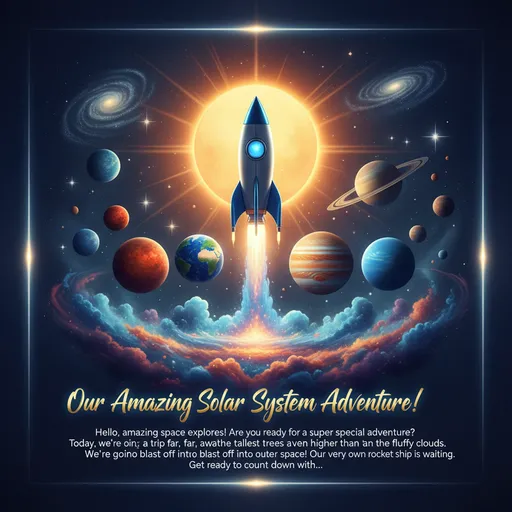
Story
Our Amazing Solar System Adventure!
15 minAges 7-9
This is the start of the story. The whole story plays in the Sonacast app.
The story
Introduction: Blast Off!
Hello, amazing space explorers! Are you ready for a super special adventure? Today, we're going on a trip far, far away, higher than the tallest trees and even higher than the fluffy clouds. We're going to blast off into outer space! Our very own rocket ship is waiting. Get ready to count down with me: five, four, three, two, one, blast off! Whoosh! We're zooming away from Earth to visit all the wonderful planets in our solar system. Each one is a unique, marvelous world, waiting for us to discover its secrets. Hold on tight, because our amazing solar system adventure is just beginning!
The Sun and Rocky Worlds
And what's the very first, biggest, brightest thing we see when we zoom out a little? It's our amazing Sun! Our Sun is not a planet, but a giant star, shining super-duper bright in the middle of everything. Imagine the biggest, warmest, glowiest flashlight you've ever seen, multiplied by a million million! That's kind of like our Sun. It gives us all our light and all our warmth here on Earth. Without the Sun, our world would be a very cold, dark, and sleepy place. It's like the biggest, friendliest campfire for our whole solar system. It pulls all the planets towards it, keeping them dancing around and around, always in their special paths. Isn't that incredible?Now, let's fly super close to the Sun, but not too close, because it's incredibly hot! The first little planet we meet on our journey is called Mercury. Say it with me: Mer-cur-y. Mercury is like a tiny, speedy race car zipping around the Sun faster than any other planet. It's the closest planet to our fiery star, so guess what? It gets super, super hot during the day, hot enough to melt crayons! But when the Sun sets, Mercury gets super, super cold. It has lots and lots of bumpy craters, like the moon, from where space rocks have bumped into it. It doesn't have any air to breathe, and no water, so we can't visit Mercury for a picnic. It's a very lonely, rocky little world, but super important because it's the first one in line!Zooming past Mercury, we come to the next planet, a beautiful, bright world called Venus. Can you say Vee-nus? Venus is almost the same size as our Earth, but it's a very different place. It's covered in thick, fluffy-looking clouds, but don't let those clouds fool you! Underneath them, Venus is even hotter than Mercury! It's the hottest planet in our whole solar system, even though it's a little farther from the Sun than Mercury. This is because those thick clouds act like a big, cozy blanket, trapping all the Sun's heat inside. Imagine wearing a giant, super-warm sweater on a sunny day – that's what Venus is like! It also spins backwards compared to most planets, and its day is even longer than its year! If you lived on Venus, a single day would feel like forever. It's a mysterious planet, shining super bright in our sky sometimes, almost like a beautiful jewel.After visiting super-hot Mercury and even-hotter Venus, let's take a quick peek back at our own amazing home, Earth! Our beautiful blue and green planet, full of water and air and trees and animals and you! See how special Earth is? It's just the right distance from the Sun – not too hot, not too cold – so that plants can grow and we can live and play. We're very lucky to have such a perfect home in space.But our adventure continues! Let's zoom past Earth to the next rocky world. This one is called Mars. Say it with me: Mars! Mars is often called the "Red Planet" because its surface is covered in reddish-orange dust and rocks. Imagine a giant desert that stretches on and on forever, painted in shades of rusty red. It's a bit smaller than Earth, and it's much colder. Brrr! While it has some air, it's not the kind we can breathe. Scientists love to study Mars because they wonder if tiny forms of life could have ever lived there, or if people might visit it one day. Mars has two tiny moons, like little potato-shaped friends, that orbit around it. They are called Phobos and Deimos. Mars has giant volcanoes, even bigger than any on Earth, though they don't erupt anymore. It also has huge canyons and polar ice caps, just like our Earth! It's a fascinating, dusty, chilly world, waiting for more secrets to be discovered. We've explored our Sun and the four rocky planets closest to it: Mercury, Venus, Earth, and Mars. Wow, what an incredible journey so far!
Giant Planets and Ringed Wonders
After our visit to Mars, our space adventure continues even further out! We're leaving the neighborhood of the rocky planets and heading towards something much, much bigger. Imagine a giant cosmic highway that separates the smaller, rocky worlds from the enormous, gassy giants. This highway is called the asteroid belt, filled with lots of rocks and space dust! Once we fly past it, we'll see our next amazing stop. Are you ready? Because here it comes! It’s Jupiter, the king of all planets in our solar system! Can you believe how enormous it is? If our Earth were a tiny blueberry, Jupiter would be a giant watermelon! It’s so big that you could fit over one thousand Earths inside it. One thousand! That's a lot of blueberries in one big watermelon! But Jupiter isn't made of rock like Earth. Oh no! It's a gas giant, a massive swirling ball of clouds and gases, mostly super light hydrogen and helium. It's like a giant, colorful striped marble floating in space. You can see beautiful bands of orange, brown, and white clouds swirling around its middle. And guess what else Jupiter has? A super famous mark called the Great Red Spot! It looks like a big, angry red eye staring out into space. But it's not an eye at all. It's an absolutely enormous storm, bigger than our entire planet Earth, and it’s been swirling and roaring for hundreds of years! Can you imagine a storm lasting longer than your great-grandparents have been alive? That's how long this storm has been going on! Jupiter also has so many moons, over 80 of them! Some are tiny, and some are as big as whole planets themselves. It's like Jupiter is always surrounded by a busy cosmic family. Zooming past Jupiter, we journey onwards to another truly magnificent planet. Get ready for a sight that will make you gasp! It’s Saturn, the dazzling jewel of our solar system! What makes Saturn so incredibly special? It’s those breathtaking rings! Imagine a giant, sparkling hula hoop made of thousands and thousands of beautiful, shimmering rings, swirling elegantly around Saturn’s middle. They look so smooth and solid from far away, but if we could get super close, we would see that they're not solid at all! They're actually made up of billions and billions of tiny pieces of ice and rock. Some pieces are as small as a grain of sand, and some are as big as a house! They all dance and twirl around Saturn, reflecting the sunlight like a million tiny diamonds. Just like Jupiter, Saturn is also a gas giant. It's a huge, puffy ball of hydrogen and helium, so light that if you could find a bathtub big enough, Saturn would float in water! Isn't that amazing? It’s not quite as enormous as Jupiter, but it’s still absolutely gigantic compared to Earth. You could fit over 700 Earths inside Saturn! Seven hundred! That's almost as many as Jupiter, just a little less. And Saturn, like Jupiter, is surrounded by a huge family of moons. It actually has even more known moons than Jupiter, over 100! One of its biggest moons is called Titan, and it’s even bigger than the planet Mercury we visited earlier! Can you believe a moon could be bigger than a whole planet? So far, we've explored the Sun, the four rocky planets – Mercury, Venus, Earth, and Mars – and now these two incredible gas giants, Jupiter and Saturn. Each one is so different and amazing in its own way! We’ve seen the biggest planet, Jupiter, with its giant red spot, and the most beautiful planet, Saturn, with its sparkling rings. Our space journey is full of wonders!
Icy Giants and Distant Worlds
Wow, what an incredible trip we've had so far! We've seen the fiery Sun, the speedy little Mercury, the super hot Venus, our own wonderful Earth, and the red planet Mars. Then we zoomed past the giant swirly Jupiter and the magnificent ringed Saturn. Each planet is truly a marvel, isn't it? But hold on tight, because our adventure isn't over yet! We're heading even further out, to the very edges of our main solar system, where things get super chilly and mysteriously beautiful. Are you ready to meet the icy giants? Let's go! Our next stop is a planet called Uranus. Can you say Uranus? It sounds a little like 'your-a-nus'. Uranus is an ice giant, which means it’s made mostly of different kinds of ice and gas, but it’s still very, very big. It's like a giant, frosty ball in space. Imagine a beautiful, pale blue-green marble, so big you could never hold it in your hands. That's a bit like Uranus! It looks like a calming, cool blue, maybe like the color of a swimming pool on a warm day, but in space it's freezing cold. And here's a super special thing about Uranus: most planets spin around like a top standing straight up. But Uranus is different! It spins on its side, like it's taking a nap while rolling through space! Isn't that silly? It just tumbles along on its side as it orbits the Sun. Scientists think maybe something big bumped into it a long, long time ago and knocked it over. So, when it moves around the Sun, one side faces the Sun for a super long time, and then the other side does! It's an upside-down, sideways adventure over there. Now, let's keep going, because even further out than Uranus, we'll find our very last big planet, a deep, deep blue world called Neptune. Neptune is the eighth and furthest true planet from the Sun. Can you say Neptune? It sounds like 'nep-toon'. If Uranus was a pale blue-green, Neptune is like the deepest, darkest blue ocean you can imagine, swirling with big, white clouds. It's another ice giant, just like Uranus, and it is incredibly cold, even colder than Uranus because it’s so much further away from the Sun. Brrr! Neptune is known for having super-duper fast winds, the fastest winds in our entire solar system! Imagine winds so strong they could blow your socks off, your shoes off, and even your hat right into outer space! These winds zoom around the planet, pushing big storms across its surface. It's a very active and stormy place, even though it's so far away and cold. It’s a very mysterious and beautiful planet, spinning quietly at the very edge of our planetary neighborhood. So, we’ve met all eight of our amazing planets: Mercury, Venus, Earth, Mars, Jupiter, Saturn, Uranus, and Neptune. What an incredible journey! But guess what? Our solar system is even bigger than these eight planets! Beyond Neptune, there’s a whole other super-duper far away place filled with even more icy worlds. It’s called the Kuiper Belt. Imagine a giant, icy donut-shaped ring way, way out there, beyond all the big planets. In this Kuiper Belt, there are lots and lots of small, icy objects, and even some special, smaller worlds called dwarf planets. One of the most famous dwarf planets in the Kuiper Belt is Pluto. Have you ever heard of Pluto? For a long time, people thought Pluto was the ninth planet, but then scientists discovered so many other icy worlds out there, some even bigger than Pluto! So, they decided to call Pluto and these other small, icy worlds 'dwarf planets'. It’s still a very important and super interesting little world, just not one of the eight big planets. Pluto is tiny, much smaller than our Earth, and it’s made of rock and ice. It’s so far away that it takes over two hundred Earth years for Pluto to go around the Sun just once! Can you imagine waiting that long for a birthday? So, as you can see, our solar system is not just about the Sun and eight planets. It's a huge, wonderful, and sometimes super chilly place, filled with so many different kinds of amazing things to discover. We’ve traveled so far, from the hot, rocky worlds to the magnificent gas giants, and now to the super cold, mysterious icy giants and even further out to the distant dwarf planets. What an adventure!
Beyond Our Solar System
Wow, what an incredible journey we’ve had, zooming past all the planets and even those distant, chilly dwarf planets at the very edge of our solar system! We’ve seen so many amazing sights, from scorching hot Mercury to the ringed wonder of Saturn, and the icy blue giants like Neptune. But now, are you ready for an even bigger adventure? Because guess what? Our solar system is just one tiny, special neighborhood in a super, super gigantic universe! It's true! Our Sun, the big, bright star that keeps us warm, is actually just one of countless stars out there. When you look up at the night sky, and you see all those tiny, twinkling lights, those are other stars, just like our Sun! Some are bigger, some are smaller, some are brighter, and some are not so bright. They are all far, far away, like sparkly diamonds scattered across a giant, dark blanket. Imagine taking all those stars, billions and billions of them, and gathering them together into a huge, swirling cloud. That, my friends, is called a galaxy! Our Sun, and Earth, and all the planets we just visited, live inside a magnificent galaxy called the Milky Way. It’s like our cosmic home! The Milky Way galaxy is so enormous, it’s hard to even imagine. If you could fly through it, it would take you a super long time, even longer than our trip across the solar system! It looks like a giant spiral, kind of like a pinwheel or a swirl of cream in your hot cocoa. It's packed with stars, and clouds of gas and dust, all swirling around and around, held together by an invisible force called gravity. And here’s another mind-blowing secret: there isn't just one galaxy in the universe. Oh no! There are billions of galaxies out there! More galaxies than you could ever count, even if you counted every single star in our Milky Way! Each one is its own sparkly island, full of stars, and maybe even planets of their own. It’s like the universe is a giant cosmic playground, with endless swings and slides and places to explore. Some of these other stars, in our galaxy and in galaxies far, far away, even have their very own planets orbiting around them, just like our Earth orbits our Sun! Scientists call these distant worlds ‘exoplanets.’ Isn’t that an exciting thought? Somewhere, far, far away, there might be another planet with mountains, or oceans, or even funny-looking plants and animals we've never seen before! We don't know yet, but it's a wonderful mystery to think about. The universe is always expanding, always growing, and there are new things being discovered all the time. It’s like a never-ending story, with new chapters always being written. So, the next time you look up at the twinkling stars in the night sky, remember that each one is a distant sun, and that our tiny solar system is just a small part of a much, much bigger and more mysterious universe, waiting for us to keep exploring its wonders.
Outro: Keep Looking Up!
Thank you for joining us on this amazing journey through our solar system! We hope you had as much fun learning about the planets and the big, wide universe as we did sharing it. There's always more to discover, so keep looking up and wondering! Maybe you'll imagine your very own space adventures. We'd love to hear what you think, so please let Sonacasts know if you have any feedback. Until our next adventure, goodbye for now!


