

Story
Puck of Pook's Hill
30 minAges 7-9
This is the start of the story. The whole story plays in the Sonacast app.
The story
Introduction
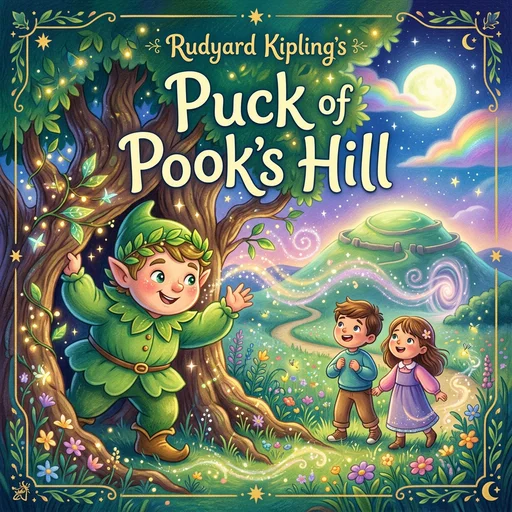
Imagine a warm, twinkly Midsummer's Eve, when the air feels full of secrets and magic! Two children, Dan and Una, are playing in a special field. Suddenly, out of nowhere, they meet a mischievous, green-clad creature with eyes that sparkle like dewdrops! This is Puck, who guards the ancient hills. He's about to take them on the most amazing journey, meeting friends from long, long ago. Are you ready to step back in time with us?
The Magic of Midsummer
Well, Dan and Una certainly were! They stared at the little green man with wide, wondering eyes. He had a cheeky smile and leaves in his hair, and he sparkled just like a summer morning after the rain. “Hello!” Puck chirped, his voice like tiny bells. “You’ve caught me on Midsummer’s Eve! And on Midsummer’s Eve, the most magical night of the year, anything can happen!” He gave a little hop. “The old magic is strongest tonight, and it allows me to bring you tales from long, long ago, right here in England’s green and pleasant land.” He gestured with a twig, and suddenly, the air around them felt… different. It felt old, and full of secrets, and very, very exciting! “Come along then,” Puck said, “our first guest is waiting. He has a story that stretches back over two thousand years, to a time when brave Roman soldiers marched across these very fields!” Dan and Una held their breath, ready for the adventure to begin.
Meeting the Roman Centurion
They followed Puck deeper into the woods, the twilight making the trees look like tall, sleepy giants. The air grew still, and then, in a little clearing bathed in the last golden light of the day, they saw him. A man stood there, tall and straight, wearing the most amazing clothes! He had shiny, strong armour on his chest, like a very clever beetle, and a big helmet with a bright red plume that bobbed gently on top. On his feet were sturdy leather sandals that looked ready for a long walk. He held a spear, not a scary one, but one that looked like it had seen many adventures. "Dan, Una," Puck announced, "allow me to introduce Parnesius. He was once a brave Roman Centurion, a captain, right here in Britannia, as this land was called long, long ago." Parnesius smiled. It was a kind smile, even though his face looked serious and wise. "Greetings, young ones," he said, his voice deep and calm, "it is a pleasure to meet children who still believe in the old magic." Una, who was always very polite, curtsied slightly. "Hello, Parnesius," she whispered. Dan, a bit more boisterous, just stared. "Wow! You're a real Roman soldier? Like in the history books?" Parnesius chuckled. "Indeed, young master. And I have many a tale to tell about my time here. About the great Wall we built to keep the land safe, about battles fought, and the friendships forged under the Roman eagles." Puck winked at the children. "See? I told you he had stories! Parnesius looked after a hundred men, you know. He knew all about marching across muddy fields, building camps, and standing guard, even when the wind howled and the rain poured." Dan imagined Parnesius leading his soldiers, their armour glinting in the sunshine, their sandals tramping through the British countryside. It was hard to believe someone from so long ago could be standing right in front of them, looking so real! "Will you tell us about the Wall?" Una asked, her eyes wide. "And what Britannia was like?" Parnesius nodded slowly. "Perhaps. But first, let us find a comfortable place to sit. My old bones aren't quite as spry as they once were, even with Puck's magic keeping them together!" He gestured towards a fallen log, and the children eagerly sat down, ready to hear tales from a time almost two thousand years past.
Tales from Hadrian's Wall
. "Ah, much better. Thank you, Puck. Now, where was I? Ah, yes. My name is Parnesius, and I was a Roman Centurion, a captain of one hundred brave soldiers. And for many, many years, my home was a place you might find quite extraordinary: Hadrian's Wall." Lily and Tom leaned closer, their eyes wide with curiosity. "Hadrian's Wall?" whispered Lily. "Indeed," Parnesius nodded. "Imagine, if you will, a great big stone serpent, stretching from one side of this island, all the way to the other! It was built by the Emperor Hadrian, a very important man, to mark the edge of our Roman world here in Britain. To keep the peace, you see. To guard against the wild, fierce tribes who lived to the north – we called them the 'Painted People' because they often painted their faces with colourful patterns." "It was a long, long wall," he continued, "almost seventy-three miles! That's like walking for days and days without stopping! And along this wall, there were many forts, like little castles, where soldiers like me lived and worked. My own fort, called Aesica, was a bustling place. Soldiers from all over the Roman Empire lived there – men from sunny Italy, from dusty Egypt, and even from the cold lands of Germany. We all spoke different languages, but we all knew how to be good soldiers together." "Life on the Wall was... bracing. Especially in winter! Oh, the wind would howl like a hungry wolf, whipping snow across the battlements. Our breath would turn to frosty clouds, and our hands would ache with the cold, even through our thick gloves." He rubbed his hands together as if remembering the chill. "But we had big roaring fires, of course, and warm woollen cloaks. And hot food too – stew, mostly, with barley and vegetables. Not quite your mum's Sunday roast, I imagine, but very warming after a long day's patrol!" Tom giggled. "Did you have to fight the Painted People?" Parnesius smiled gently. "Sometimes, yes. But mostly, we watched. We were like big, watchful owls, always keeping an eye out. Our job was to make sure no one sneaked across the Wall without permission. Sometimes, the Painted People would try to steal a few sheep, or maybe just be curious about what we were doing. They weren't always bad, you know. Just... different. They loved their own land, just as we Romans loved ours." "I remember once, a very mischievous fox caused more trouble than any Painted Person! It kept sneaking into the fort's kitchens, trying to snatch bits of bread. We tried everything – setting traps, chasing it with brooms – but that fox was too clever! It would always find a way. One day, our cook, a very grumbly but kind man named Marcus, decided to leave a small piece of cheese out by the back door. And sure enough, the fox came, took the cheese, and never bothered us again! Marcus swore it was a peace offering." Lily clapped her hands. "A clever fox!" "Very clever indeed," Parnesius agreed. "But back to the Wall. It wasn't just a barrier; it was a way of life. We built roads, towns grew up around our forts, and even baths – yes, Roman baths, even in the cold north! We tried to bring a little bit of Rome to this wild, beautiful place. We learned to live with the harsh weather, and we learned to respect the land." "The Wall stood for hundreds of years, a testament to Roman ingenuity and determination. It was a place where different cultures met, sometimes clashing, sometimes learning from each other. We stood guard, day in and day out, watching the seasons change, from the bright greens of spring to the stark white of winter. We were the guardians of the frontier, making sure Roman Britain was safe." "It could be lonely sometimes, far from home. But we had each other. Soldiers are like a family, you see. We shared our food, our stories, and our hopes for the future. And sometimes, when the sun set over those wild hills to the north, painting the sky in fiery colours, it felt like we were at the very edge of the world, protecting something precious." "It was a grand time, full of responsibility and adventure. But even the strongest walls can't stand forever against the shifting sands of time. Eventually, the legions were called away... but that, perhaps, is a story for another day." He looked at the children, a gentle smile on his face. "Are there any other questions about my time on the Wall, my little historians?"
Knights and Castles
Puck suddenly appeared, his eyes twinkling. "For today, we have new tales, from a time when England was a land of grand castles and shining knights!" He continued, "Imagine kings and queens living in huge, stone houses, protected by thick walls and brave warriors." The air shimmered, and *poof!* There stood a knight! "Good morrow, young folk!" the knight boomed, his voice echo-y from inside his gleaming, silver armour. It clinked softly as he moved. "This," Puck announced, "is Sir Cuthbert, a most honourable knight from the time of castles!" "Indeed!" Sir Cuthbert nodded, his helmet plume wobbling. "Our homes were not like your cosy cottages. Our homes were *castles*!" "Can you picture a castle?" Puck asked, "Think of great, stone walls, so tall they tickled the clouds! And at the top, pointy towers where guards watched." Sir Cuthbert added, "Around the outside, sometimes, a big ditch filled with water! We called it a *moat*. Good at keeping out grumpy dragons... or neighbours!" The children giggled. "To get across the moat?" Puck prompted. "Ah, the drawbridge!" Sir Cuthbert exclaimed. "A giant wooden bridge, pulled up high so no one could get in! *Clunk-whirr-thud!* That was the sound!" "Inside," Puck went on, "it was like a whole town! Kitchens, busy courtyards, and big, echoing halls for feasts." Sir Cuthbert nodded vigorously. "And *we* knights," he puffed out his chest, "we were the protectors! Strong, brave, and always doing what was right!" "Did you fight dragons, Sir Cuthbert?" asked a child. He chuckled, "Not *actual* fire-breathing dragons, little one, not usually. But sometimes, we protected our castles from... other knights who weren't so honourable!" "To be a knight," Puck explained, "you trained from a young age! First as a page, then a squire, helping a knight and learning to use a sword." "And finally," Sir Cuthbert finished, "if you were brave and true, you became a knight! We wore shining armour, carried colourful shields, and rode magnificent horses into... well, sometimes it was just to the market, but sometimes it was a grand adventure!" "Tell us about a grand adventure!" one child urged. Sir Cuthbert pondered. "Hmm, I remember one time! My lord had a splendid pet, a talking parrot named Polly. Polly knew all the castle secrets! Like where the best biscuits were hidden!" Puck chuckled. "Well," Sir Cuthbert continued, "one morning, Polly flew right out of the window! *Squawk!* My lord was terribly upset!" "So, what did you do?" "My duty, of course!" the knight declared. "I put on my finest armour, polished my shield, and mounted my trusty steed, Sir Galahad the Second!" Puck whispered, "A horse with such a grand name!" "Indeed!" Sir Cuthbert confirmed. "We rode out, across the drawbridge – *clunk-whirr-thud!* – and into the big, green forest. We searched and searched, past tall oaks and bubbling brooks. My armour got dusty! We called, 'Polly? Polly, where are you?'" "And then?" "And then," Sir Cuthbert paused dramatically, "we heard a tiny *squawking* sound! From the top of the tallest oak tree! There was Polly, perched on a branch, telling a squirrel where the best acorns were hidden!" "So you rescued her?" "Well, I tried to climb the tree in my armour," Sir Cuthbert admitted, "but it's rather heavy. So, Sir Galahad the Second, being a very clever horse, gave a mighty nudge to the tree trunk, and a shower of leaves and acorns rained down! And with them, Polly! *Squawk!* She landed right on my shoulder, chattering away about the squirrel's nut collection." The children laughed. "And that," Sir Cuthbert concluded, "was my grand adventure! Protecting the castle's secrets, one talking parrot at a time. It wasn't always about big battles. Sometimes, being a knight was about being kind, clever, and helping your friends." "Thank you, Sir Cuthbert," Puck said, "You have shown us that courage comes in many forms, and that even the smallest quests can be the most important." Sir Cuthbert bowed, his armour clanking. "Farewell, young historians! May your days be filled with honour and... delicious hidden biscuits!" And with another *poof!* he vanished. "Wasn't he just wonderful?" Puck asked, "A true knight, even if his armour was a little squeaky!"
Before the Castles
Puck chuckled, his eyes twinkling like far-off stars. "Oh, yes, knights were quite splendid in their day. But you know, before all those grand, strong castles, and even before the knights with their shiny swords, England looked very, very different indeed." He paused, wiggling his leafy ears. "Would you like to know what it was like? What came *before*?" "Come closer," Puck whispered, beckoning with a twig. "We're going to travel back further than you can ever imagine! Close your eyes and think of green, green fields, ancient forests stretching on forever, and no tall buildings anywhere, just the sky and the trees." "Open your eyes!" Puck exclaimed, and suddenly, the air felt different. The smell of woodsmoke tickled their noses, and a gentle breeze rustled through what looked like very old, rough wooden fences. "Look!" he pointed. "Do you see those little houses?" Puck asked, his voice full of wonder. "They're not like the houses you live in today, are they? These are called 'longhouses'. They're made of wood and mud, with roofs of straw, all snug and warm." He led them towards a clearing. "This, my dear friends, is an Anglo-Saxon village, thousands and thousands of years ago!" "See the little children running about?" Puck continued,. "They're playing with carved wooden toys, or chasing chickens, just like children do now, only everything looks a little bit simpler, a little bit wilder." "Their clothes are made of wool and linen, spun right here in the village by busy hands." "Over there," Puck pointed with a gnarled finger, "do you see that boy, no older than yourselves, helping his mother? His name is Aethel. He's learning to weave baskets from reeds he gathered by the river. *Whoosh, whoosh*, goes the reeds as he pulls them tight." "Life here is all about helping each other," Puck explained,. "The men go hunting in the forests with bows and arrows, or fish in the clear rivers. The women look after the homes, prepare food, and make beautiful clothes and pottery." "Every evening, everyone gathers around a big fire in the middle of the village. And what do you think they do then?" "They tell stories!" Puck answered,. "Oh, such wonderful stories of brave warriors, and mischievous forest spirits, and clever animals. Stories to teach them about their world, and to make them laugh!" "There are no shops here, no big towns," Puck said,. "Everything they need, they make themselves, or they find in the forest or the fields. Their food comes from the ground – vegetables and grains – or from the animals they raise, like pigs and cows, or the deer they hunt." "Imagine waking up to the sound of roosters crowing, and the smell of bread baking over an open fire!" Puck exclaimed,. "No alarm clocks needed here! Just the sun peeking over the ancient trees." "Aethel is trying very hard to finish his basket," Puck observed,. "It's for carrying berries they'll pick later. But look, one of the reeds has snapped!" "Oh dear, that's a bit tricky, isn't it?" "But Aethel doesn't give up," Puck continued,. "He remembers what his father taught him: 'If something breaks, find a way to mend it, or find a new way to make it work!' So, he finds a stronger reed, and with a little *snip-snip* from his mother's sharp knife, he starts again. And this time, it holds!" "Soon, Aethel's basket is finished, strong and sturdy, ready for berry picking!" Puck said,. "See? Even without big machines or fancy tools, they made wonderful things with their own hands and clever minds." "You might be wondering," Puck said,, "if there were no big stone castles, how did these people keep safe?" He tapped his chin thoughtfully. "Well, they built strong wooden fences around their villages, like the one you saw. And sometimes, they would dig deep ditches, called 'dykes', around their homes too." "But their strongest defence," Puck explained,, "was their community. Everyone looked out for everyone else. If there was trouble, they would all work together, like a big, brave team." "This land, our England," Puck said,, "has been home to people for such a very, very long time. And for many hundreds of years, before any castles were ever built, it was brave folk like Aethel and his family who lived here, building their homes, telling their stories, and making their own way." "They loved their land just as much as we do today." "And do you know what else they loved?" Puck leaned in,. "The trees! The forests were their supermarkets, their toy shops, and their playgrounds!" He giggled. "They knew all the secrets of the woods, how to find the juiciest berries, which mushrooms were safe, and where the most playful squirrels liked to hide. Every tree was a friend, and every forest was an adventure!" "What an exciting world, wasn't it?"
Pirate Ships and Queens
Indeed it was! Every corner of our land, every ancient tree, every winding river, held a secret or a story, didn't it? But, dear children, as the leaves turn and the seasons change, so too do the stories of England. Our island, this green and pleasant land, has always been a place of grand adventures, not just on the land, but on the sparkling, wide sea too! Can you imagine, a ship, bigger than your biggest house, with tall, tall masts that scraped the clouds and sails as white as giant swan's feathers? Imagine it bobbing gently on the blue, blue ocean, miles and miles from shore. The wind would fill its sails, pushing it across the waves, taking brave sailors to places they'd only ever dreamt of! They weren't just looking for treasure, oh no! They were looking for new friends, new lands, and new adventures! Puck clapped his hands together, a sound like dry leaves rustling. “Ah, the sea! The great, big, splashy sea! It called to the people of England like a delicious biscuit calls to a hungry child! They built strong ships, made of sturdy oak, with big anchors to hold them steady. And they learned to read the stars, like a map in the night sky, to find their way across the watery world.” “Sometimes,” Puck continued, leaning in conspiratorially, “these ships would sail with flags fluttering high, carrying goods and gifts to far-off lands. But sometimes… sometimes they would go on very special missions. Missions to explore, to discover, to see what lay beyond the horizon! Think of it like a giant treasure hunt, but instead of gold coins, they were looking for new stories, new plants, and new friends!” He spread his arms wide. “Our island, you see, is quite small, but it’s right next to the biggest puddle in the world – the ocean! And for many, many years, England needed brave sailors to protect its shores. Imagine tiny little boats, but full of courage, facing off against bigger, scarier ships! It was like a game of hide-and-seek, but on the water, with the waves as your wobbly playground!” And who do you think was in charge of this grand island, sending out these brave sailors and these magnificent ships? Why, a magnificent Queen, of course! A Queen with fiery red hair, like a sunset, and dresses so grand they looked like a rainbow had spilled over them, sparkling with jewels and shimmering silks. She wore a crown, not just for decoration, but because she was a very important person indeed! She was Queen Elizabeth the First, a lady who loved her country more than anything else. She sat on her throne, a big, comfy chair covered in velvet, and listened to all the stories of the brave sailors. She would hear about their journeys, about the stormy seas, and about the wonderful new things they had seen. She wanted England to be safe and strong, and she wanted her people to be happy and proud. So, she encouraged her sailors to be the bravest of the brave, to sail the furthest, and to protect their home with all their might. “She even had a special friend,” Puck whispered, “a very clever and brave sailor called Sir Francis Drake. He wasn’t a pirate who stole from everyone, oh no! He was more like a super-sailor, sailing around the whole world in his ship, the Golden Hind, protecting England’s interests and finding amazing new places. He would bring back fascinating stories and sometimes, even a bit of treasure, to make England even richer and stronger!” “Imagine,” Puck said, his eyes twinkling, “a whole fleet of these wonderful ships, sailing out from the English harbours, their flags snapping in the wind, like happy puppies wagging their tails! They were called the Royal Navy, and they were the best sailors in the whole wide world! They would sail to hot, sunny lands where exotic birds sang songs you’d never heard before, and trees grew fruit so sweet you’d think it was candy.” “And sometimes,” he added, “they would even have a little cheeky battle with other ships who tried to bother England! It was like a very grand game of dodgeball on the ocean, with cannons instead of balls, but don't you worry, our sailors were very, very good at it! They defended their home with such courage, making sure that England remained a safe and happy place for everyone.” “So, you see,” Puck concluded, looking out across the imaginary sea, “England wasn't just about knights in shining armour and ancient folk in the woods. It was also about brave sailors, magnificent ships, and a powerful Queen who steered her country through choppy waters with wisdom and courage. Every wave that gently laps our shores today carries echoes of those grand sea adventures, if only you listen very, very closely.”
The Whispers of the Land
Every wave that gently laps our shores today carries echoes of those grand sea adventures, if only you listen very, very closely. And it's not just the sea, my dears, that holds such marvellous echoes. England itself is like a giant, ancient storybook, written not with ink and paper, but with hills and rivers, old stones and rustling leaves. If you quieten your minds and open your hearts, you can almost hear the whispers of the land, telling tales of everyone who has ever lived here. Imagine standing on a green, grassy hill. Perhaps a hill where, hundreds and hundreds of years ago, a brave Roman centurion might have marched, his armour gleaming in the sun. He would have looked across the same fields, perhaps seen the same kind of clouds drifting by. The earth beneath your feet remembers his heavy boots, the little stones remember the rumble of his cart. It's all there, waiting to be noticed. Or think of a grand old oak tree, its branches spreading wide like welcoming arms. That tree might have been just a tiny sapling when the very first folk of England danced beneath its leaves, long before castles were built or queens ruled. It's seen so many seasons, felt so many winds, heard so many songs. It’s like a living library, full of silent stories, if only we knew how to read its ancient bark. And those mighty castles we talked about, with their thick stone walls and tall towers? Even when they’re crumbling ruins, they still hum with tales of knights and ladies, of feasts and tournaments, of times when kings and queens made their homes within those very stones. Every mossy brick, every archway, every winding staircase has a story to tell about the people who built them and the lives lived inside. You can almost hear the clatter of swords, the laughter from a grand hall, or the gentle strum of a lute, if you close your eyes and truly listen. Puck smiled, his eyes twinkling like stars. “Yes,” he said, “the land remembers everything. The rivers remember the boats that sailed upon them, from tiny fishing coracles to grand Viking longships. The winding lanes remember the carriages that trundled along them, carrying goods and people from one village to the next. Even the pebbles on the beach remember the tides, and the tiny shells whisper secrets of the deep, deep sea, just like our brave sailors heard.” He gestured with a small, green hand towards the horizon. “England is alive with these whispers. Every hill has a name, and often, that name tells a piece of its story. Every stream has travelled through so much time, past so many different lives. It’s not just a place on a map; it’s a tapestry woven with countless threads of history, every thread a person, an event, a brave deed, or a quiet moment of happiness.” “But how do we hear them, Puck?” asked Dan, looking around with wide, eager eyes. “We don’t hear any people talking from the stones!” Puck chuckled, a sound like dry leaves rustling. “Ah, not with your ears, my young friends, not always. You hear them with your imagination. You hear them when you look at a funny old stone wall and wonder who built it, and why. You hear them when you see a field of sheep and remember that people have been farming these same fields for thousands of years. You hear them when you feel the wind on your face and imagine it’s the same wind that blew through a Roman camp, or ruffled the plumes on a knight’s helmet.” “It’s about connecting. It’s about understanding that everything you see around you, from the smallest daisy to the biggest mountain, has a past. It’s all part of England’s big, grand story. And the best part? You are now part of that story too. Your footsteps on this land add to its whispers for the future.” Puck picked up a small, smooth pebble from the ground and turned it over in his fingers. “Think of all the hands that might have held this very pebble throughout time. Perhaps a Roman child played with it. Perhaps a knight kicked it aside as he rode by. Perhaps a Queen’s messenger paused here, resting before continuing his urgent journey. This little stone has seen more history than many books could ever hold.” He gently placed it back on the grass. “It’s quite a treasure, isn’t it?” “It’s amazing,” Una breathed, looking at the pebble as if it were a jewel. “So everywhere we go, there are stories waiting to be found?” “Precisely!” Puck exclaimed, clapping his hands softly. “Everywhere! In your own village, in the trees outside your window, in the soil of your garden. The land is always speaking, sharing its memories, if you just take a moment to listen with your heart and your imagination. It makes every walk an adventure, doesn't it? Every cloud a picture, every gust of wind a message.” He looked at the children, his eyes twinkling even more brightly. “These whispers of the land tell us that we are all part of a long, wonderful chain. From the Romans to the ancient folk, from the brave knights to the daring sailors, and now to you, playing here on this very spot. You are living the next chapter of England’s great story. And that, my dears, is a truly magical thing.”
Outro
And so, our adventure with Puck of Pook's Hill comes to a cosy close for today. Thank you ever so much for joining us on this magical journey, my little listeners! We hope you've enjoyed every moment. Do let Sonacasts know if you have any thoughts or favourite parts – we'd love to hear from you! Perhaps you’ll even imagine your own secret, magical places now. Keep exploring, keep dreaming, and never stop believing in a bit of everyday wonder. Cheerio for now!
More stories
- Lily and the Sparkling Unicorn15 min · Ages 3-5

- The Tale of the Three Little Pigs60 min · Ages 7-9

- The Story of King Arthur and His Knights30 min · Ages 7-9
- The Ugly Duckling: A Tale of Self-Discovery60 min · Ages 7-9

- The Bell of Bramblewick Wharf20 min · Ages 7-9

- The Moon Goes on a Picnic5 min · Ages 7-9
